Fall Prevention for Seniors: The Checklist That Actually Works
Almost every fall prevention checklist starts the same way. Take a walk through the house, pick up the throw rugs, put a bar in the shower, and call it finished. None of that is bad advice. It is just not the part that changes the most.
Effective fall prevention for seniors starts with the body and the daily routine, then moves to the house. A medication that quietly drops your blood pressure when you stand up will undo every grab bar you install. A pair of legs that have not done anything harder than a walk to the mailbox in two years will too.
So here is the checklist in the order that actually matters, built from what we see in Bay Area homes every week. Some of it takes a phone call. Some of it takes a Saturday afternoon. All of it is worth more than another trip to the hardware store.
The short version: the four changes that lower fall risk the most are a medication review with your doctor or pharmacist, regular balance and strength work, an up to date eye exam with current glasses, and clear lighting on the paths you walk every single day. Everything else on this list supports those four.
If part of the reason you are reading this is that someone in the family thinks it might be time for a medical alert button, that question deserves a real answer rather than a sales pitch. Our guide on how to choose a medical alert system walks through it without pushing anything.
Start With the Medication List
A medication review is the single fastest win on this checklist, and it costs nothing but a phone call. Several very common prescriptions raise fall risk as a side effect, and most people taking them have never been told.
The usual suspects are blood pressure medications, sleep aids, sedatives, some antidepressants, muscle relaxants, and anything that causes drowsiness or lightheadedness. The risk is not the drug by itself. It is the combination, and it is the dose that made sense five years ago at a different body weight.
Book a review with the prescribing doctor, or take the whole bag to a pharmacist. Bring everything, including over the counter sleep aids and supplements, because those count too. Ask one direct question: does anything on this list affect balance or blood pressure when I stand up?
This is also the moment to mention something that is worth watching. Medicare is preparing a falls prevention demonstration called LEAD, scheduled to begin in January 2027, which would pay doctors specifically for addressing fall risk with older patients. It is a demonstration rather than a nationwide benefit, so do not wait for it. But it does mean the conversation you are about to start with your doctor is one the system is beginning to take seriously.
Balance and Strength Work Is the Only Thing Proven to Reduce Falls
Exercise is the one item on this checklist with the strongest evidence behind it. Home modifications reduce hazards, but balance and leg strength reduce the actual likelihood of going down, and that difference matters.
You do not need a gym. The two things that count are lower body strength and standing balance, and both improve at any age. Sit to stand from a dining chair without using your hands, ten times, is a real strength exercise. Standing on one foot at the kitchen counter while the kettle boils is a real balance exercise. Heel to toe walking down the hallway is another.
Tai chi has the best track record of any single class format, and the Bay Area is generous with it. Most senior centers in Alameda and Contra Costa counties run a class, often free or close to it, and September is National Senior Center Month, which is a fine excuse to walk in and ask. Group classes also solve the harder problem, which is doing it consistently.
One honest caution. If balance is already shaky, do the standing exercises with a countertop or a sturdy chair within arm’s reach. The goal is to build confidence, not to test it.
Get the Eyes and the Feet Checked
Vision and footwear are the two quiet risk factors almost nobody puts on a checklist, and both are straightforward to fix. An out of date prescription changes how you judge a step down. Bifocals and progressive lenses distort where the floor appears to be, which is exactly the wrong thing on a staircase.
Get an eye exam annually. If you wear progressives and take stairs often, ask your optometrist about a single vision pair kept for walking around. Cataracts are worth asking about directly, since the surgery is routine and the improvement in depth perception is immediate.
Feet get even less attention. Backless slippers, worn out soles, and going barefoot on hardwood all raise risk. What you want is a shoe with a firm back, a low broad heel, and a sole with grip, worn inside the house as well as outside. Numbness or pain in the feet is worth a doctor visit on its own, because it changes how well you feel the ground underneath you.
Not sure where your parent’s home stands? Call our Oakland office at (510) 338-3466 to talk it through, or book an in-home visit. Our technicians look at the whole house while they are there, not just the equipment.
Clear the Paths You Walk Every Single Day
Now the house, and specifically the routes you travel without thinking. Research consistently finds that environmental hazards contribute to roughly half of senior falls, which means the floor is worth real attention even though it is not the top of the list.
Walk the three paths that matter most: bed to bathroom, bedroom to kitchen, and front door to car. Those are where falls happen, because they are traveled in the dark, in a hurry, or carrying something.
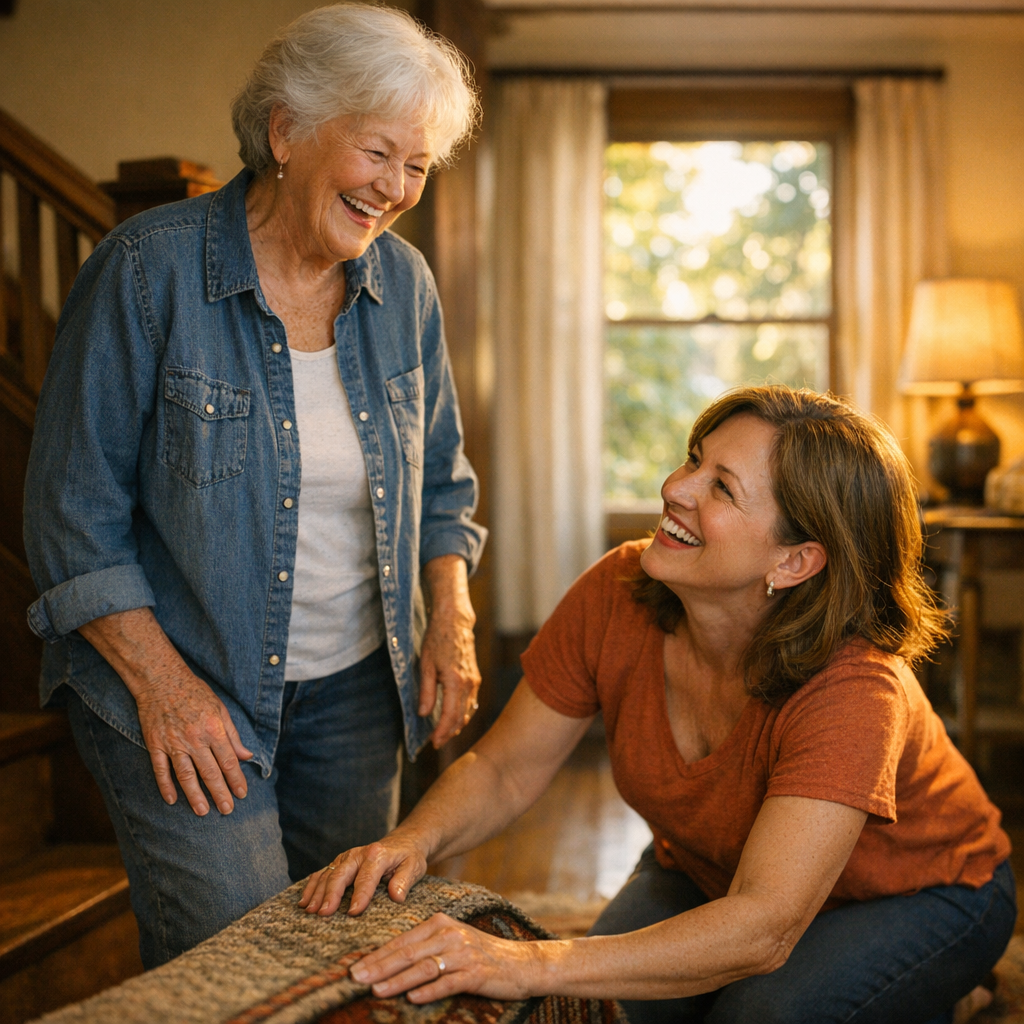
On each path, look for loose rugs, extension cords crossing open floor, a step down you have stopped noticing, pets that wind around your ankles, and anything stored on the floor that used to live on a shelf. Rugs either come up or get taped down at every edge. Cords go around the room, not across it.
The bathroom deserves its own pass, since it packs hard surfaces, water, and awkward movement into a small space. Our guide to bathroom safety for seniors covers grab bar placement in detail, including the one thing to never use as a handhold, which is the towel bar. For a full walkthrough of the rest of the house, the aging in place home safety checklist goes room by room.
Fix the Lighting and the Reaching
Lighting and reach are the two home fixes with the best return for the least money. Most falls at home happen in low light, and most of the rest happen while somebody is stretching for something.
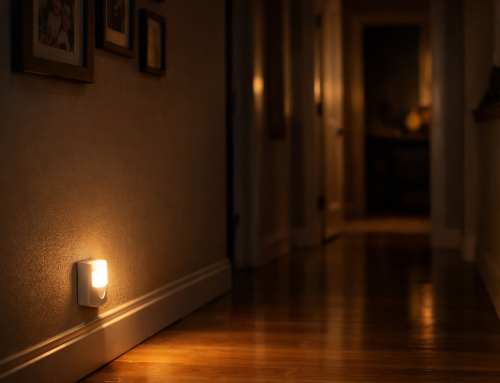
Put a motion sensor night light in the hallway between the bedroom and the bathroom. Put a lamp within arm’s reach of the bed so nobody crosses a dark room to reach a wall switch. Check that the stairwell has a working bulb and, ideally, a switch at the top and the bottom. Add a light at the front door, since the walk from the car after dark is a common spot.
Then handle reaching. Move the everyday dishes, the coffee, and the cereal to the shelf between hip and shoulder height. Anything that requires a step stool goes to a lower shelf or to someone else’s job. Step stools and folding chairs are not ladders and should not be treated as ladders.
Handrails belong on both sides of any staircase, and they should extend past the top and bottom step. If your railing wobbles when you lean on it, it is decoration rather than a handrail, and it should be tightened this week.
Plan for the Fall That Happens Anyway
Even a household that does everything on this list can still have a fall, and a plan for that is part of prevention rather than an admission of defeat. The thing that turns a minor fall into a serious one is usually the wait, not the impact.

The plan has three parts. Someone checks in daily, even briefly. A spare key lives in a lockbox so paramedics do not have to force a door. And there is a way to call for help from the floor, which a phone left on the kitchen counter is not.
That last piece is where a medical alert button earns its keep, particularly for someone who lives alone. At home, the Home Link runs $29.00 per month, month to month with no contract, with fall detection available as a $10.00 per month add on. For someone still driving to the store and walking at Lake Merritt, the Mobile X is $44.95 per month with fall detection built in and works anywhere with cell coverage.
Automatic fall detection is worth understanding before you buy it, because it is a backup rather than a replacement for pressing the button. Our piece on fall detection and fall prevention explains where it helps and where it does not.
💡 Coming home from the hospital is the highest risk window there is. New medications, less strength, and an unfamiliar routine stack up at once. Here is what to set up before discharge day.
Falls Prevention Awareness Week in the Bay Area
Falls Prevention Awareness Week runs September 21 to 25, 2026, and it is the easiest week of the year to get free help with this checklist. Senior centers across Alameda, Contra Costa, San Mateo, and Santa Clara counties schedule balance screenings, home safety talks, and tai chi demonstrations that week, and most do not require an appointment.
You will find us at a fair number of them. Vital Link has been a family owned company on Telegraph Avenue in Oakland since 1981, and our technicians spend their days driving to homes from Berkeley to San Jose to Walnut Creek. That is the part a national brand cannot copy. When we set up a system, an actual person stands in the actual hallway, notices the rug at the bathroom door, and says something about it.
September is a good month for this in general. Grandparents Day falls on Sunday, September 13, and the Solano Stroll brings Albany and Berkeley out onto the street in the same stretch. If the family is already gathering, an hour spent walking the house together is an hour well used, and it is a much easier conversation than the one that happens after an ambulance visit.
We cover all nine Bay Area counties. If you want the specifics for where you live, start with our Alameda County page or the broader Bay Area medical alert systems overview.
Talk to a Real Local Person
You can reach us directly, and you will get someone in Oakland rather than a call center in another state.
- Call us at (510) 338-3466
- Visit our contact page to schedule an in-home visit
- Serving Alameda, Contra Costa, Marin, Napa, San Francisco, San Mateo, Santa Clara, Santa Cruz, and Solano counties
- No long term contracts, no rate increases, free lockbox, and special pricing for veterans and Meals on Wheels recipients. Just ask when you call.
Keep Reading
| Aging in Place Home Safety Checklist The room by room walkthrough, from the front steps to the bedroom. |
Read More |
| Bathroom Safety for Seniors The highest risk room in the house, and the inexpensive fixes that work. |
Read More |
| Senior Wellness Habits That Keep You at Home Eight daily habits behind strength, balance, and staying independent. |
Read More |
| How to Talk to a Parent About a Medical Alert System The conversation that goes badly when it is rushed, and how to open it well. |
Read More |
Sources
- Centers for Disease Control and Prevention: Older Adult Falls Data and Research
- Centers for Disease Control and Prevention: STEADI, Stopping Elderly Accidents, Deaths and Injuries
- National Council on Aging: Falls Prevention for Older Adults
- National Council on Aging: Falls Prevention Awareness Week
- National Institute on Aging: Falls and Fractures in Older Adults, Causes and Prevention
- Forbes: Medicare to Pay Docs to Reduce Falls by Seniors
Still Deciding Whether a Button Makes Sense?
Talk it through with a local person in Oakland. No pressure, no contract, and an honest answer about whether you need one yet.
Frequently Asked Questions
What is the single most effective fall prevention step for seniors?
Balance and strength exercise has the strongest evidence behind it, and a medication review is the fastest to complete. Do the medication review this week because it takes one phone call, then start the exercise, because that is the piece that keeps working month after month.
How often should a home fall safety check be done?
Once a year is a reasonable rhythm, and Falls Prevention Awareness Week in September is an easy reminder. Do an extra check any time something changes, such as a hospital stay, a new medication, a new diagnosis, or a noticeable change in walking.
Does Medicare pay for fall prevention?
Medicare covers an annual wellness visit that can include a fall risk assessment, and it covers physical therapy when a doctor orders it. A demonstration program called LEAD is scheduled to begin in January 2027 that would pay doctors specifically for addressing fall risk, but it is a limited demonstration rather than a nationwide benefit, so ask your own doctor what is available to you now.
Is fall detection worth the extra cost?
It is worth it for someone who lives alone, has fallen before, or has a condition that could cause a sudden loss of consciousness. Treat it as a backup rather than a replacement for pressing the button, since no fall detection is perfect. It is built in on the Mobile X and Mobile W, and it is a ten dollar per month add on for the at home devices.
Do you install medical alert systems in person in the Bay Area?
Yes. A local technician comes to the home, sets everything up, tests it with you, and shows you how it works. That is how we have done it since 1981, and it covers all nine Bay Area counties. Nothing arrives in a box for you to figure out alone.