Bathroom Safety for Seniors: The Highest Risk Room in the House
If you only fix one room this year, fix the bathroom. It is small, it is wet, every surface in it is hard, and almost everything you do in there requires balance.
The good news is that bathroom safety for seniors is mostly inexpensive. A handful of parts from a hardware store, an afternoon of work, and the room stops being the risky one. No remodel required.
This guide walks through what actually works, what looks helpful but is not, and the one modification almost nobody thinks of until a paramedic is standing outside a locked door.
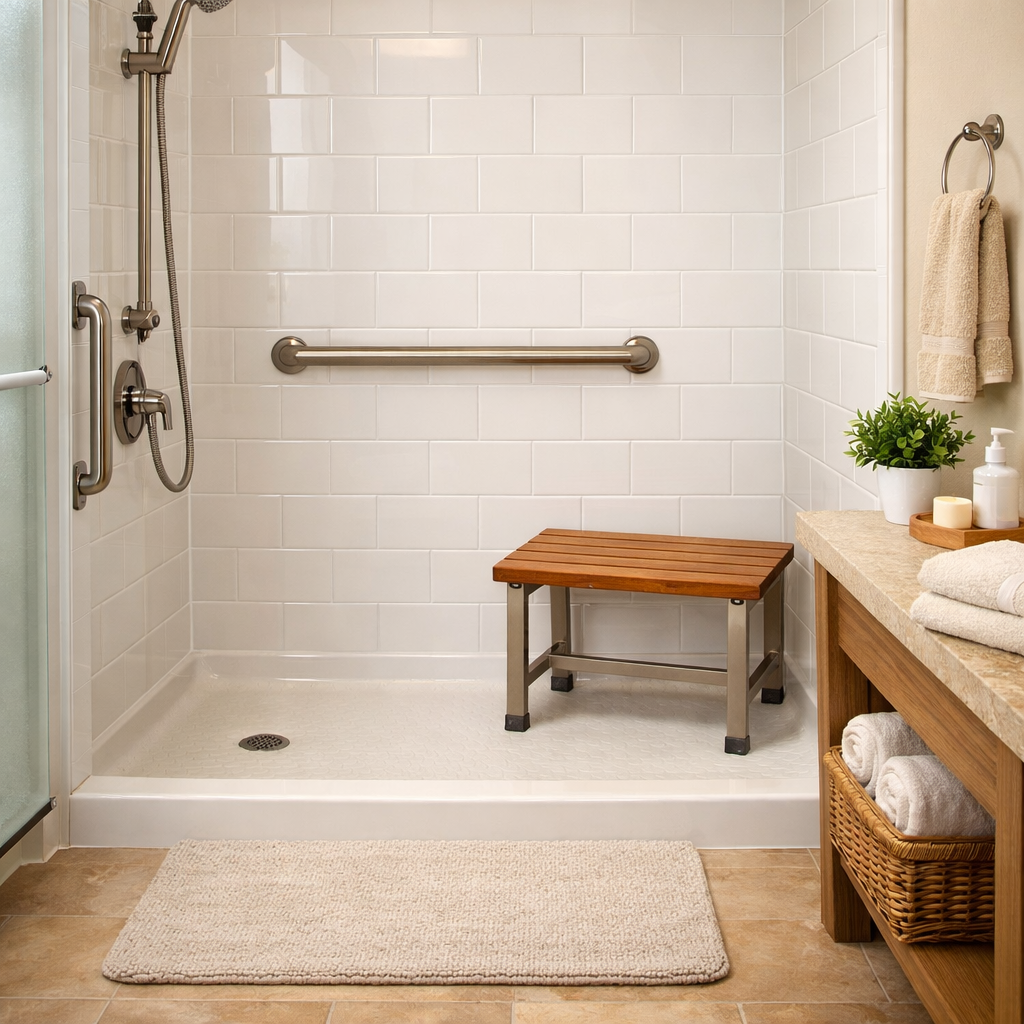
The short answer, if you want it in one paragraph. Bathroom safety for seniors comes down to four things: something solid to hold at the tub and the toilet, a surface that does not get slick, a way to sit down while washing, and a light that is on before you walk in. Get those four right and the room is transformed.
Families across Alameda and Contra Costa counties ask us to look at the bathroom during an install, and our technicians will tell you honestly what needs work, which is one reason people book an in-home visit before buying anything.
Grab Bars Have to Be Real Grab Bars
A grab bar only works if it is anchored to hold a person’s full weight, which means it goes into a stud or into a properly rated hollow wall anchor. Suction cup handles and towel bars are the two things we see most often standing in for a grab bar, and both have given way at the exact moment someone needed them.
Put one bar at the entry to the tub or shower, positioned so it can be gripped while stepping in and while standing inside. Put a second one on the wall inside, roughly at chest height when standing. If the shower has a seat, add a bar within easy reach of the seated position.
Beside the toilet, a bar on the wall or a frame that mounts to the toilet itself takes the strain off knees and shoulders during the sit and stand. This is the movement people quietly start avoiding, and avoidance leads to dehydration and worse.
Choose bars with a textured finish rather than polished chrome, since wet hands slide on smooth metal. Colors that contrast with the wall help too. A white bar on a white tile wall is genuinely hard to find in a hurry.
Deal With Water Before It Reaches the Floor
Wet tile is the most slippery surface in the house, so the goal is to keep water contained and give feet something to grip. A non-slip mat or adhesive strips inside the tub handle the first part.
Outside the tub, use a bath mat with a rubber backing that lies flat, and take it up if the corners start to curl. A folded towel on the floor is not a bath mat. It slides.
A handheld shower sprayer reduces splash and lets someone wash while seated, which keeps water where it belongs. It is a twenty minute install on most fixtures and it is one of the highest value changes on this list.
If the shower has a lip or a curb to step over, that step is where balance is tested most. A transfer bench that spans the tub wall lets a person sit down outside and slide in, which removes the step entirely. Physical therapists recommend these constantly, and families almost never think of them.
Worried about the shower specifically? Call our Oakland office at (510) 338-3466 and we will talk through what makes sense for the bathroom, or book an in-home visit.
Sitting Down Is Not Giving Up
A shower chair is the single most effective bathroom change, because it removes standing balance from the equation entirely. Standing on one foot to wash the other, with eyes closed and shampoo running, is a demanding balance task at any age.
Pick a chair with rubber feet, adjustable legs, and a back if there is room. Test the height so feet rest flat on the floor. Many people resist this one because it feels like a concession, so it helps to frame it the way physical therapists do: the chair means longer, more thorough showers, not fewer of them.
The toilet is the other seat worth thinking about. A raised seat or a comfort height toilet, roughly two to four inches higher than a standard one, makes standing up far easier on the knees and hips. Combined with a grab bar, it turns a strenuous movement into an ordinary one.
If getting in and out of the bath has become genuinely hard, that is worth mentioning to a doctor rather than working around quietly. Sometimes it is strength, sometimes it is a medication side effect, and sometimes it is treatable.
Light the Room Before You Walk Into It
The 3 a.m. bathroom trip is the one that causes the most trouble, because it happens half asleep, in the dark, and often quickly. The fix is to never require anyone to find a switch.
Put a motion sensor night light in the hallway and another inside the bathroom, low on the wall. Choose warm light rather than bright white, which is easier on eyes adjusting from sleep. Keep the main switch reachable from the doorway without stepping into the room.
Older eyes need substantially more light than younger ones to see the same edge, so a bathroom that seems adequately lit to a visiting adult child can be dim to a parent. When in doubt, add light.
Glare matters too. A shiny floor under a single bright bulb creates a reflection that reads as a wet patch or hides a real one. Diffused light from two sources beats one harsh ceiling fixture.
The Modification Nobody Thinks Of: the Lock
Most bathroom doors have a privacy lock that can be opened from the outside with a coin, a small screwdriver, or a straightened paperclip. Confirm yours is one of those, and hang the tool on a small nail beside the door frame.
If the door has a keyed lock or a slide bolt, change it. A person on the bathroom floor behind a bolted door turns a manageable situation into a forced entry, and forced entry takes minutes that matter.
Think about the door swing while you are there. A door that opens inward can be blocked by someone who has fallen against it. Reversing the hinges so it opens outward, or replacing it with a pocket or barn style door, solves that permanently.
This is also where a lockbox earns its keep. If help has to come from outside, a key in a lockbox means the door gets opened rather than broken. Every Vital Link client gets a lockbox free, and here is why those minutes matter so much.
What Happens if Someone Cannot Get Up
Everything above lowers the chance of a fall. None of it shortens the wait afterward, and that wait is what determines how bad a fall turns out to be. A person who gets help in ten minutes generally recovers. A person on a cold tile floor for eight hours often does not return to the same level of independence.
A medical alert button worn in the shower closes that gap. Vital Link buttons are waterproof and designed to be worn while bathing, which matters because the bathroom is exactly where people take them off.
For someone home most of the day, the Home Link is $29.00 per month, month to month with no contract. With no landline in the house, the Cellular Home Link is $34.95 per month. Fall detection is a $10.00 per month add-on on both, and it is worth considering for anyone whose bathroom is a concern, since a fall that knocks someone out cannot be reported by hand.
For someone still out walking, gardening, or riding BART to see grandkids, the Mobile X at $44.95 per month includes fall detection and works anywhere there is cell service.
💡 Wear it in the shower. The most common reason a button does not help is that it was on the nightstand. Ours are waterproof, so the habit is simple: it stays on. How fall detection and prevention work together
Local Technicians, Not a Shipping Box
Vital Link has been family owned since 1981, with an office on Telegraph Avenue in Oakland. A technician comes to the house, decides with you where the equipment belongs, and runs a live test with the monitoring center before leaving.
In a bathroom that matters. Signal behaves differently through tile and plumbing than it does through drywall, and a base unit placed in the living room may not hear a button pressed at the far end of a hallway. That is the kind of thing you find by testing in the actual house, not by reading a range specification on a box.
We serve Alameda, Contra Costa, Marin, Napa, San Francisco, San Mateo, Santa Clara, Santa Cruz, and Solano counties. No long term contracts, no rate increases after signup, and special pricing for veterans and Meals on Wheels recipients. Ask when you call.
- Call us at (510) 338-3466
- Visit our contact page to schedule an in-home visit
- Serving Alameda, Contra Costa, Marin, Napa, San Francisco, San Mateo, Santa Clara, Santa Cruz, and Solano counties
Keep Reading
| Senior Home Safety in the Bay Area Overlooked hazards that cause most emergency calls. |
Read More |
| Fall Detection and Fall Prevention Why the two together make a complete plan. |
Read More |
| How a Lockbox Saves Precious Minutes What happens when the door is locked and nobody can open it. |
Read More |
| Medical Alert Systems in Contra Costa County In-person installation from Walnut Creek to Richmond. |
Read More |
Sources
- CDC: Older Adult Falls Data
- CDC STEADI: Stopping Elderly Accidents, Deaths and Injuries
- National Institute on Aging: Preventing Falls at Home: Room by Room
- National Council on Aging: Falls Prevention for Older Adults
- AARP: Livable Communities
A Waterproof Button Changes the Bathroom
Talk to someone in Oakland about which system fits the home, with no contract and no pressure.
Frequently Asked Questions
What is the most important change for bathroom safety for seniors?
Properly anchored grab bars at the tub and the toilet. They must go into a stud or a rated hollow wall anchor. Suction cup handles and towel bars are not substitutes and have failed people at the moment they were needed most.
Can a medical alert button be worn in the shower?
Yes. Vital Link buttons are waterproof and designed to be worn while bathing. That matters because the bathroom is both the highest risk room and the place people are most likely to take a button off.
Is a shower chair a sign of losing independence?
No, and physical therapists recommend them widely. Washing while standing on one foot is a demanding balance task at any age. A shower chair usually means longer and more thorough showers, not fewer.
How do I make sure paramedics can get into a locked bathroom?
Use a privacy lock that opens from the outside with a coin or small screwdriver, and hang the tool near the door. Replace keyed locks and slide bolts. A lockbox with a spare house key also lets responders in the front door without forcing it.
Does fall detection work in the bathroom?
Yes, and it is the room where it matters most, since a fall that knocks someone unconscious cannot be reported by pressing a button. Fall detection is built into Mobile X and Mobile W and is a $10.00 per month add-on on the at-home systems.